Member Spotlight
Tell us about your organization
The Village of Arts and Humanities (opens in new tab)is a nonprofit in North Philadelphia’s Fairhill-Hartranft neighborhood that uses art to envision and generate a thriving community where Black residents are leaders, stewards, and ultimate beneficiaries of reinvestment.
The Village’s ideas and actions are informed by the expressed interests, observed needs, and deep, trusted relationships with community residents—our neighbors.
The Village’s creative campus—a network of non-contiguous art parks, gardens, and buildings spanning 4.5 acres of urban land—has bent and molded itself to respond to the ideas, creative products, and experiences of our community. For more than 70 years, the space has been well used and well-loved by thousands of artists, community members, activists, educators, and entrepreneurs. It’s witnessed and held performances, community dinners, showcases, exhibits, celebrations, rehearsals, and creative production.
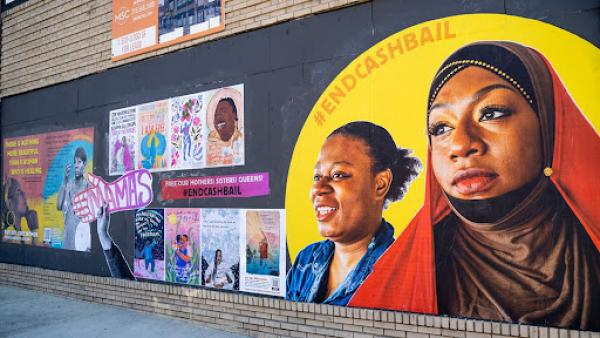
Our ground-level work blends art with social justice, neighborhood revitalization, and youth development. We are working on several efforts to change the narrative around incarceration, including the People’s Paper Co-op, an art and activism project focused on women in reentry based at The Village (PPC mural pictured above). We are also a proud coalition member of Care, Not Control (opens in new tab), which seeks to end the carceral state for Pennsylvania youth and reinvest in communities.
We are the official stewards and Corridor Managers of the 2500-2800 blocks of the Germantown Avenue Commercial Corridor and Lehigh Avenue between 11th and Hutchinson Streets. Our goal is to work with business owners and residents to make The Avenue a clean, safe commercial corridor that meets neighborhood shopping needs and attracts destination shoppers.
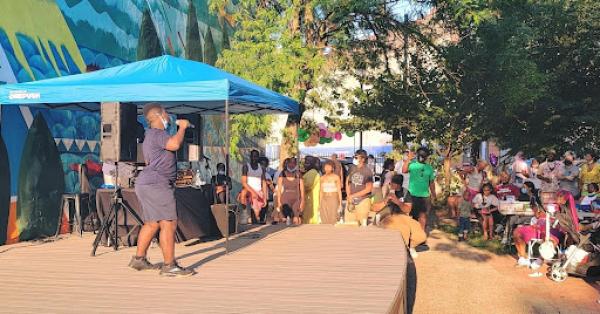
Our award-winning Village Industries program offers excellent arts education and paid creative opportunities to youth. Taught by top working artists, our programs challenge young people to focus on their passions and explore their capabilities. The program allows them to learn about dance, music production, vocal production, fashion design, photography, and ceramics. Philly Earth, part of Village Industries, is our environmental education, urban farming, and youth leadership program. It engages youth, neighbors, and volunteers in designing, building, and stewarding our quarter-acre urban demonstration farm and its sustainable structures.
How have you evolved as an organization?
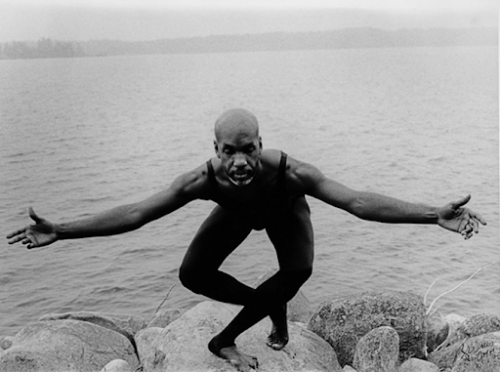
The Village of Arts and Humanities celebrates its 36th anniversary this year, but our story began with renowned dancer, choreographer, and civil rights activist Arthur Hall (pictured below). In 1969, he erected Ile Ife Black Humanitarian Center at 2544 Germantown Avenue, which is now The Village’s main building. He invited neighbors, regardless of skill, to become experts in dance and drumming. For Arthur, cultural engagement was the most effective tool for healing and shaping the physical and social characteristics of the disinvested Fairhill-Hartranft neighborhood.
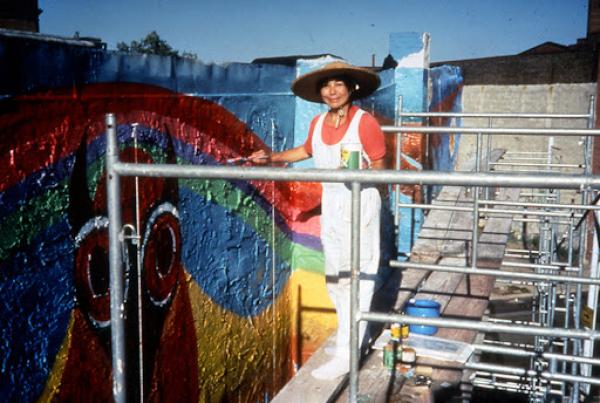
At Arthur’s invitation, iconic artist Lily Yeh (pictured below) visited the area in 1986 and created The Village as a successor to Ile Ife. She worked with community members to infuse and evolve Ile Ife’s aesthetics within arts programming and the physical landscape. Together they built murals and undulating walls that referenced symbols of the African diaspora and used mosaics and concrete to enable neighbors to participate in the building process, thus rendering spaces sacred through shared creation.
Using civic art practice, both Arthur and Lily encouraged people to believe in and help build a more beautiful and just future for themselves and their families. Today, The Village remains a community-rooted, anchor institution with 15 art parks and 12 program buildings, annually impacting 1500 community residents, enlisting the help of 400 volunteers, and engaging 550 youth that attend The Village’s after-school and summer programs.
How does The Village approach its work?
The way we work is inspired by the ideas and practices of those who came before us, like Arthur and Lily. We use arts-based thinking and doing to keep, make, and transform meaning. “Arts-based thinking” is the ability to move forward without a template, to move past or even destroy previous success or challenge, and to hold multiple truths and ideas as equally valid.
We also center co-creation, which allows us to develop mutual value (in programs, products, policies, etc.) in collaboration with community members, stakeholders, and other experts. Co-creation is a manifestation of shared power where ideas are challenged, developed, and affirmed together, rather than kept to oneself or one group.
Additionally, The Village prioritizes Futures Thinking, where we imagine and consider an unlimited and unencumbered range of possible futures. We do not limit ourselves by the constructs, tools, and policies created through white supremacy, heteronormativity, and capitalist patriarchy; we do not limit ourselves by the current availability of resources; we do not limit ourselves by what is. We imagine and create what can and should be.
Lastly, we invest in strengths and assets. We believe people are inherently creative and want to shape their own experiences. Every person has unique gifts critical to upholding individual and community-based self-determination. It is our mandate to nurture, amplify, and honor these gifts.
What are you most excited about right now?
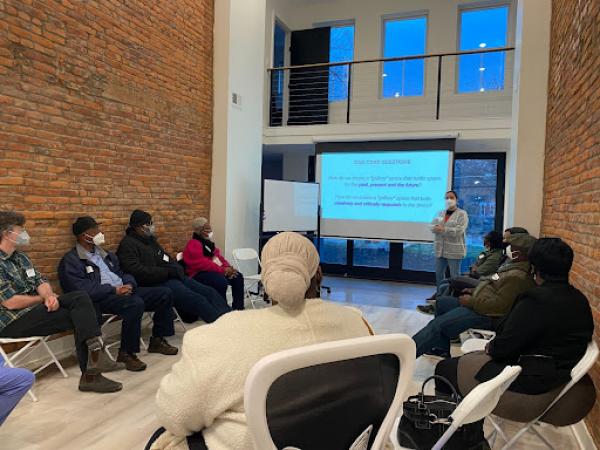
The Village’s campus has been undergoing an exciting transformation that helps us better invest in our community and the programs that support them. We recently opened our Civic Power Studio, a gathering space and media lab on North Alder Street. It brings community members together to study how power operates, amplify existing neighborhood power, and build new systems of power rooted in care rather than control.
We are also in the process of working with our community to develop the Futures Gallery, which we are building as an extension of our main building. This space will serve as a powerful cultural and economic tool for resilience—for community residents past-present-future, The Village, and Black working artists across Philadelphia. We see it as a tool to combat the physical and cultural erasure of Black communities.
We plan to mark these transformational developments with a campus celebration open to the broader public in the coming months. Please follow The Village on Instagram, Facebook, and Twitter, and sign up for our e-blast to stay updated on all of these developments.